Easter Island (Rapa Nui)
Jeff's Blog
.JPG)
So Barbara and I have always been curious about this island and its "mysteries". So we decided to spend Christmas vacation there. We left Santiago on December 19th and returned on the 26th. The island is isolated to the east of the Polynesian archipelagos, pretty much accessible only through Santiago (2300 miles away), charter flights and cruises, so this was our chance. The nearest inhabited island is Pitcairn, (1300 miles to the west) the site of the Bounty mutineers' descendants.
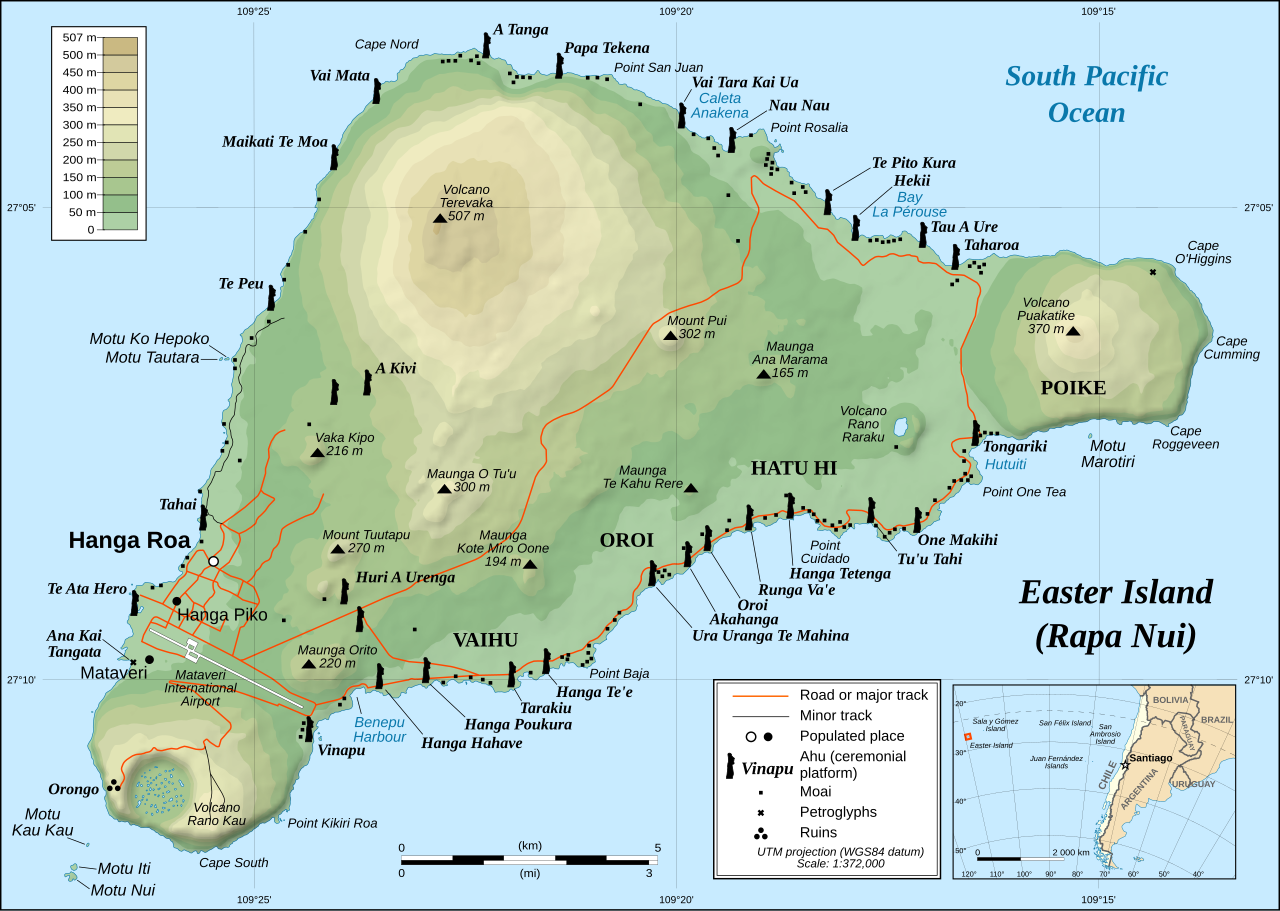
The first thing one has to know about Easter Island (Rapa Nui) is that it has only about 5,000 inhabitants, most of whom live in Hanga Roa. So while this map of the island makes it look substantial, it is really not very large...one can drive around it in a leisurely 45 minutes...at the max posted 60 KPH.
We didn't really understand this when we arrived, so we hired a private guide to take us around, figuring that we could cover a lot of ground and go back for more intensive visits later. So, learning by word of mouth about Josie Nahoe Mulloy (in the blue shirt below), the granddaughter of American Archaeologist William Mulloy, who worked with Thor Heyerdahl in the late 50's and remained for quite a while. Heyerdahl was convinced that the inhabitants of Rapa Nui as well as many Polynesians descended from the indigenous peoples of South America. Mulloy, who had previously specialized in American indigenous archaeology came along to look into it.


Rapa Nui is a volcanic island, created by gaps in the Nazca plate that resulted in three separate volcanos, easily identifiable on the map. So there is only one real beach and the landscape is rocky. So when the first Rapanui arrived (probably from the Marquesas) they probably landed at Anakena (north part of the island) to a scene like this (minus the Moai and the people). There was only about 200 meters of sand beach here, but a lot more forest.

So the original king, Hotu Matu'a, arrived in a couple of sea-going canoes with his family. It is surmised through oral tradition that they left their home island because of overcrowding. No one is sure when they arrived, but evidence shows that they arrived no later than 1200 C.E. The king supposedly had seven sons and he split the island in wedges for them, and through the years, exploitation of resources made it harder and harder to live there. Sporadic contact with Europeans came in the 18th century, and like in many new world stories, the Rapa Nui people were almost wiped out by the contact in the 19th century in slaving raids from Peru and a psychotic Frenchman who tried to turn the whole island into a sheep ranch. However, even before the Peruvian raids of 1862, the Rapa Nui themselves had engaged in violent clan wars, toppling Moai, which were reported standing as late as 1770 and all toppled by 1825.
The Moai

Yes, so everyone comes for the Moai. Yeah, they are very cool and more numerous than what you might expect. Lots of archaeologists and anthropologists have patiently worked here for more than 70 years and they have found some pretty interesting tidbits about life and beliefs on the island. The Rapa Nui seem to have had a ruling class formed around ancestor worship. According to our guide (and I have heard many versions of this, because no one really knows) the Moai faced inland to a ceremonial space in the village (remember that the seven sons moved all about the island, each with their own waterfront).

The Moai were placed on their seat (called an Ahu) and almost all faced away from the ocean toward where archaeologists have established the villages were. The reason the Moai ring the island (see the map) is because every descending clan of the seven sons had to have their own Moai, because, representing their ancestors, the Moai could store mana (spiritual energy) for the village.
The Moai are pretty amazing feats of neolithic engineering on an island with limited materials, but apparently an abundance of food to support intense mining, transportation, and construction feats. The parts of these monuments come from several places on the island, but the main body of the Moai, which generally consists of a single piece head and body (with carved decoration like arms, fingernails, belts, beards, belly buttons, etc) which was topped with a red scoria top knot, and had coral and obsidian eyes.


Because the rock used to carve most moai was tuff (compressed volcanic ash) it was easy to carve, but also is easily eroded by the elements. The moai on the right is from the British Museum, stolen by those rapacious British in the 1860's (they would also raze structures in search of quite a few other artifacts as well). However, the good thing about this theft was that Hoa Hakananai'a is in good condition...much better than his brothers on Rapa Nui. At 10 tons, it must have made excellent ballast for the HMS Topaze.
So the Rapa Nui chiefs would allocate men to work in the quarry at Rano Ronaku on the edge of a crater in the northeastern part of the island. This for me was one of the most outstanding sites on the island. Here are unfinished Moai that represent half of the total on the Island. According to Josie, the carvers would work the Moai from the cliff face in a rough form, then move them out to a finishing area.

You can see one that appears to have been in progress laying from bottom up in the center. Actually, right around him are several in progress. This one would have been a giant at over 40 feet tall. Once carved out rough, they would excavate under, replacing the stone with wooden pegs for support. When it was time to lever him out, the carvers wood slowly lever him up using rocks as jacks to support him as he got higher and higher. Thus, the Moai would be "born" of the land and slid down to a finishing area like the ones below.


No one knows why so many Moai were never finished and abandoned after the hard work of carving them out of the mountain. It is interested to see them in various stages of preparation. It is also obvious that the styles were changing over time and that the Moai were abandoned at different periods. This fellow may be an early prototype that was excavated by archaeologists.

This sitting fellow seems to have been a smallish prototype that never got carried out. However, he is nonetheless pretty magnificent. After the Moai were finished (polished with pumice and prepared for the journey...eyes and topknot would be added on the Ahu later), the villagers would start the long slow process of moving them across the island to their new homes. Because the quarry site only allowed a couple of exits, one can see various Moai along a main route across the island.


End of Part One - More to Come

No comments:
Post a Comment